Vehicle fires can develop rapidly and may result from electrical faults, fuel leaks, mechanical failures, overheating, accidents or improperly installed aftermarket equipment. While regular vehicle maintenance and responsible driving practices remain the foundation of vehicle safety, appropriate fire-protection equipment can provide an additional layer of protection.
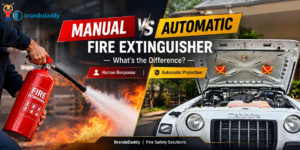
An automatic car fire extinguisher is designed to provide automatic fire suppression when its specified activation conditions are reached. Unlike a conventional manual fire extinguisher, which requires a person to identify the fire and operate the device, an automatic system can respond without requiring immediate manual activation.
This makes automatic fire protection particularly relevant for selected vehicle compartments and high-risk areas where early intervention may help limit the development of an incipient fire.
However, automatic fire extinguishers are not a substitute for vehicle maintenance, emergency procedures or professional firefighting. The equipment must be appropriate for the specific fire risk, vehicle type and installation environment.
This guide explains how automatic car fire extinguishers work, common causes of vehicle fires, considerations for petrol, diesel, CNG and electric vehicles, installation factors, selection criteria and the role of automatic fire protection in a broader vehicle fire-safety strategy.
Why Is Vehicle Fire Safety Important?
Modern vehicles contain several systems and materials that can contribute to fire risk, including electrical wiring, batteries, fuel systems, lubricants, plastics, rubber components and high-temperature mechanical parts.
Vehicle fires may be associated with:
- Electrical or mechanical failures
- Fuel or fluid leaks
- Damaged wiring
- Overheating
- Collisions
- Battery-related incidents
- Improperly installed aftermarket accessories
- Inadequate maintenance
The National Fire Protection Association identifies mechanical and electrical problems among common causes of vehicle fires and recommends paying attention to warning signs such as fluid leaks, damaged wiring, recurring fuse failures and abnormal engine temperatures.
Therefore, vehicle fire safety should not be viewed only as an emergency-response issue. It should be approached as a combination of prevention, maintenance, appropriate fire protection and emergency preparedness.
What Is an Automatic Car Fire Extinguisher?
An automatic car fire extinguisher is a fire-suppression device designed to activate automatically when its specified activation condition is reached.
A conventional manual extinguisher requires a person to:
- Detect or notice the fire.
- Access the extinguisher.
- Operate the device.
- Direct the extinguishing agent toward the fire.
An automatic system is designed to provide an initial response without depending entirely on immediate human intervention.
This can be useful where the fire may originate in an enclosed or less visible area of a vehicle.
However, automatic activation does not mean that a product is suitable for every fire scenario. The selection of an automatic fire extinguisher should consider the type of fire risk, protected area, vehicle configuration, operating environment and manufacturer’s specifications.
How Does an Automatic Fire Extinguisher for a Car Work?
The exact operating mechanism depends on the design of the product. In general, automatic fire-suppression systems operate through the following sequence:
1. Fire or heat develops
A fire begins within the protected area.
2. The activation mechanism responds
When the specified activation condition is reached, the device activates.
3. The suppression agent is released
The fire-suppression agent is discharged according to the product’s design.
4. The developing fire is suppressed
The agent acts on the fire within the protected area.
5. Further fire development may be reduced
Early intervention may help limit the development of an incipient fire. Actual effectiveness depends on factors such as fire type, fire size, location, ventilation, installation and product suitability.
The principal advantage of automatic activation is that the initial suppression response does not depend entirely on a person being present and immediately able to operate a manual extinguisher.
Where Can Automatic Fire Protection Be Used in a Vehicle?
Automatic fire protection may be considered for selected areas where a vehicle-specific fire risk exists.
Depending on the vehicle and product, these may include:
- Engine compartments
- Electrical equipment areas
- Battery-related compartments
- Fuel-system areas
- Commercial vehicle equipment compartments
- Other enclosed or designated high-risk areas
There is no universal installation location for every automatic fire extinguisher.
The installation position should be determined according to the manufacturer’s instructions, the vehicle configuration and the area intended to be protected.
The device should not interfere with:
- Steering
- Pedals
- Vehicle controls
- Airbags
- Driver visibility
- Passenger movement
- Moving mechanical components
- Other safety-critical systems
For professional or commercial vehicle applications, installation should be undertaken or reviewed by a competent person where appropriate.
Common Causes of Vehicle Fires
Understanding the causes of vehicle fires is an important part of prevention.
Electrical faults
Damaged wiring, loose electrical connections, incorrect modifications, overloaded circuits and repeated fuse failures can increase fire risk.
Fuel and fluid leaks
Petrol, diesel, engine oil and other combustible fluids may become hazardous when exposed to sufficiently high temperatures or ignition sources.
Mechanical failures and overheating
Mechanical faults and abnormal operating temperatures should be investigated promptly rather than ignored.
Aftermarket modifications
Additional lighting, audio equipment, chargers and other accessories may create electrical risks when incorrectly installed.
Collisions
A collision can damage electrical wiring, batteries, fuel systems and other vehicle components.
Inadequate maintenance
Failure to address warning lights, unusual smells, fluid leaks or electrical problems can allow developing faults to become more serious.
Regular servicing and timely attention to warning signs are therefore essential components of vehicle fire prevention.
Automatic vs Manual Car Fire Extinguishers
Automatic and manual extinguishers should not necessarily be viewed as competing technologies. They can serve complementary roles within a broader fire-safety strategy.
| Factor | Automatic Fire Extinguisher | Manual Fire Extinguisher |
|---|---|---|
| Activation | Automatic according to product design | Requires manual operation |
| Human intervention | Not required for initial activation | Required |
| Installation | Installed in a designated location | Stored for access |
| Response | Can respond automatically | Depends on human detection and reaction |
| Typical purpose | Additional protection for selected risk areas | Manual response to suitable incipient fires |
| Key limitation | Requires correct product selection and installation | Requires a person to access and operate it |
The appropriate approach depends on the vehicle, fire risk and applicable requirements.
Automatic Fire Extinguishers for Petrol and Diesel Vehicles
Petrol and diesel vehicles contain several potential fire-risk sources, including fuel, electrical systems, engine components and combustible materials.
When selecting an automatic fire extinguisher for such a vehicle, consider:
- The fire types covered by the product
- Intended application
- Installation requirements
- Operating temperature range
- Environmental conditions
- Manufacturer documentation
- Applicable standards and certifications
- Inspection, replacement or maintenance requirements
The Bureau of Indian Standards identifies IS 15683:2018 as the Indian Standard covering portable fire extinguishers, including requirements related to performance, reliability and safety. The Fire Extinguishers (Quality Control) Order, 2023 references this standard for portable fire extinguishers.
However, a standard applicable to portable fire extinguishers should not automatically be assumed to cover every type of automatic vehicle-specific fire-suppression device. The applicable requirements for the exact product should be verified with the manufacturer.
Fire Safety Considerations for CNG Vehicles
CNG vehicles require particular attention to their fuel systems, cylinders, fittings and associated components.
Vehicle owners should follow the applicable manufacturer and regulatory requirements for inspection and maintenance.
An automatic fire extinguisher may provide an additional layer of fire protection where the product is specifically suitable for CNG vehicle applications. It should not, however, be considered a substitute for proper CNG-system maintenance.
Warning signs such as suspected gas leakage, unusual odours, damaged components or abnormal vehicle behaviour should be addressed promptly by an appropriate professional.
Where there is an immediate safety concern, occupants should move away from the vehicle and seek appropriate emergency assistance.
Fire Safety Considerations for Electric Vehicles
Electric vehicles require additional consideration because they contain high-voltage electrical systems and, in many cases, high-voltage battery packs.
An EV fire may therefore involve hazards that differ from those associated with conventional petrol or diesel vehicles.
Emergency-response guidance for high-voltage vehicles highlights electrical hazards and specific considerations for responding to battery-related incidents.
If an EV shows signs such as smoke, sparks, unusual heat or suspected battery damage:
- Stop in a safe location where possible.
- Switch off the vehicle when safe to do so.
- Evacuate all occupants.
- Move to a safe distance.
- Prevent others from approaching the vehicle.
- Contact emergency services.
- Follow the vehicle manufacturer’s emergency-response instructions.
Vehicle owners should not assume that a compact fire extinguisher can safely control every type of EV battery fire.
BrandsDaddy Car AFE: Automatic Fire Protection for Vehicles
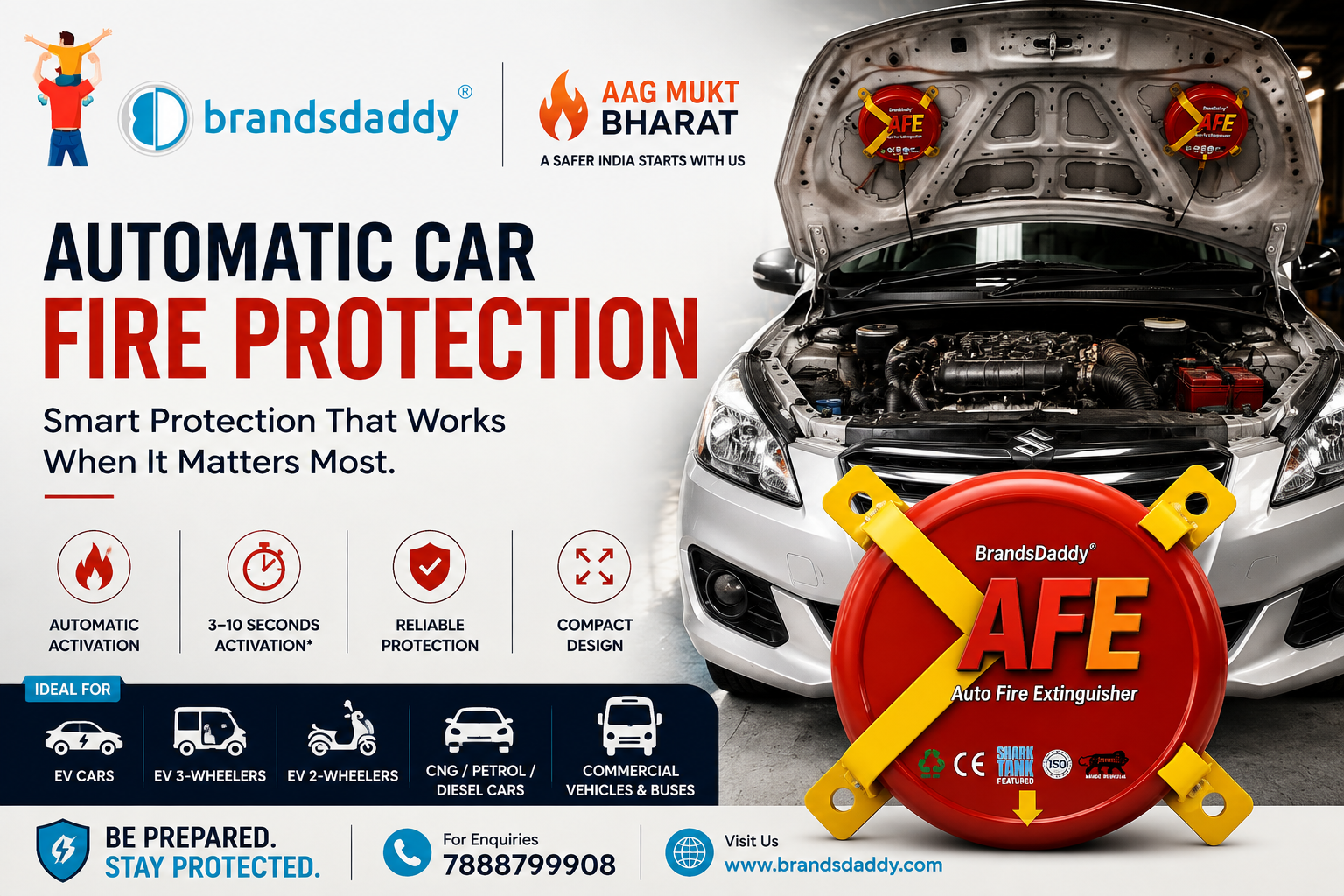
BrandsDaddy offers the Car AFE, an automatic fire-extinguishing solution intended for vehicle applications.
BrandsDaddy Car AFE is designed for applications including EV two-wheelers, EV three-wheelers, EV cars and buses, CNG cars, CNG commercial vehicles, petrol and diesel cars, commercial vehicles, buses and trains.
The product is designed with automatic activation and a compact form factor for specified vehicle applications.
Theproduct is designed to activate in approximately 3–10 seconds in the presence of flame, as specified for the product.
Product specifications, performance information, certifications and other technical claims should always be verified against the latest manufacturer documentation before purchase or installation.
How to Choose an Automatic Car Fire Extinguisher
Selecting vehicle fire-protection equipment should begin with the fire risk rather than the product name.
1. Identify the vehicle type
Consider whether the vehicle is:
- Petrol
- Diesel
- CNG
- Electric
- Hybrid
- Commercial
2. Identify the area requiring protection
Determine whether the primary concern is an engine compartment, electrical area, battery compartment, fuel-related area or another designated space.
3. Check the product’s fire coverage
Review the manufacturer’s documentation to confirm that the product is appropriate for the anticipated fire risk.
4. Review installation requirements
The device should be installed according to the manufacturer’s instructions and without interfering with vehicle operation or occupant safety.
5. Consider environmental conditions
Vehicle compartments can experience heat, vibration, dust, moisture and temperature variations. The product should be appropriate for its intended operating environment.
6. Verify documentation
Before purchasing, request or review:
- Technical specifications
- Installation instructions
- Intended applications
- Applicable standards
- Test or certification documentation, where applicable
- Warranty terms
- Replacement or maintenance requirements
A responsible fire-safety purchase is based on documented suitability rather than marketing claims alone.
Where Should a Car Fire Extinguisher Be Installed?
The correct installation location depends on the product and the vehicle.
For an automatic extinguisher, the device should generally be positioned to protect the intended risk area while maintaining safe clearance from:
- Moving parts
- Excessive heat
- Electrical components where inappropriate
- Driver controls
- Airbags
- Passenger areas
- Other safety-critical systems
The manufacturer’s installation instructions should always take precedence.
For commercial fleets or specialized vehicles, a professional assessment may be appropriate.
10 Common Car Fire-Safety Mistakes
1. Ignoring unusual burning smells
An unusual smell may indicate an electrical, mechanical or fluid-related problem.
2. Ignoring visible smoke
Smoke should always be treated as a potential warning of a serious problem.
3. Replacing blown fuses without investigating the cause
Repeated fuse failures may indicate an underlying electrical fault.
4. Using poorly installed electrical accessories
Improper modifications can introduce additional electrical risks.
5. Ignoring fluid leaks
Fuel, oil or other fluid leaks should be investigated promptly.
6. Installing fire-protection equipment without considering the risk area
The effectiveness of a fire-protection device depends partly on appropriate application and installation.
7. Assuming every extinguisher is suitable for every fire
Fire extinguishers are designed for specific fire risks and applications.
8. Assuming automatic activation guarantees fire extinguishment
Automatic activation does not eliminate the limitations associated with fire size, fire type, installation and surrounding conditions.
9. Neglecting equipment inspection
Fire-protection equipment should be maintained or replaced according to manufacturer requirements.
10. Prioritising the vehicle over personal safety
During a serious vehicle fire, occupants should evacuate and move to safety rather than attempting to save the vehicle.
What Should You Do If Your Vehicle Catches Fire?
If smoke or flames are detected, personal safety should be the immediate priority.
Step 1: Stop safely
Move the vehicle away from traffic or other immediate hazards if this can be done safely.
Step 2: Switch off the vehicle
Turn off the engine or vehicle system when safe to do so.
Step 3: Evacuate
Ensure all occupants leave the vehicle.
Step 4: Move away
Maintain a safe distance from the vehicle and keep other people away.
Step 5: Contact emergency services
Seek professional assistance.
Step 6: Do not return to the vehicle
Do not re-enter the vehicle to collect personal belongings.
Step 7: Avoid unnecessary firefighting
Only attempt to use fire-protection equipment when the fire is small, the equipment is appropriate and doing so does not place anyone at risk.
NFPA’s vehicle-fire guidance similarly recommends evacuating occupants, moving away from the vehicle and contacting emergency services.
Vehicle Fire-Safety Checklist
Use this checklist as part of your regular vehicle-safety routine:
- Regularly service the vehicle.
- Investigate unusual smells or noises.
- Do not ignore dashboard warning lights.
- Check for fluid leaks.
- Address electrical problems promptly.
- Avoid improperly installed electrical modifications.
- Follow the manufacturer’s maintenance recommendations.
- Ensure installed fire-protection equipment remains in its intended position.
- Follow equipment inspection and replacement instructions.
- Keep emergency contacts accessible.
- Know how to safely evacuate the vehicle.
- Never compromise personal safety to protect property.
Is an Automatic Fire Extinguisher Enough to Protect a Car?
No single fire-safety product should be considered complete protection against every possible vehicle fire.
A more effective approach combines several layers:
Fire Prevention
↓
Regular Vehicle Maintenance
↓
Early Identification of Warning Signs
↓
Appropriate Fire Protection
↓
Emergency Preparedness
An automatic car fire extinguisher can form one part of this layered approach.
Its value depends on selecting a product appropriate for the specific application and installing it correctly.
Frequently Asked Questions
What is an automatic car fire extinguisher?
An automatic car fire extinguisher is a fire-suppression device designed to activate automatically when its specified activation condition is reached. It can provide an additional layer of protection in suitable vehicle fire-risk areas.
Is an automatic fire extinguisher suitable for cars?
It can be suitable when the product is specifically designed for the intended vehicle and fire risk. Always verify the manufacturer’s specifications and installation requirements.
Where should an automatic car fire extinguisher be installed?
The appropriate location depends on the product, vehicle configuration and area being protected. Installation should follow the manufacturer’s instructions and should not interfere with vehicle operation or occupant safety.
Can an automatic fire extinguisher be used in an EV?
Some automatic fire-protection products are designed for EV applications. However, EV battery fires can involve specialised hazards, and vehicle owners should follow manufacturer and emergency-service guidance.
Can an automatic fire extinguisher be used in a CNG car?
It can be considered where the manufacturer specifically identifies the product as suitable for CNG vehicle applications. Proper inspection and maintenance of the CNG system remain essential.
Is an automatic car fire extinguisher better than a manual extinguisher?
Not necessarily. Automatic and manual extinguishers serve different purposes and can potentially complement each other as part of a broader fire-safety strategy.
Can one extinguisher handle every type of vehicle fire?
No. The suitability of a fire extinguisher depends on the type of fire, suppression agent, product design and intended application.
How quickly does BrandsDaddy Car AFE activate?
The BrandsDaddy Car AFE is designed to activate in approximately 3–10 seconds in the presence of flame, as specified for the product.
Does a car fire extinguisher replace regular vehicle servicing?
No. A car fire extinguisher is an additional fire-protection measure and should not be considered a replacement for regular vehicle servicing. Vehicle owners should continue to follow the manufacturer’s recommended maintenance schedule and address electrical, mechanical or fuel-related issues promptly. The BrandsDaddy Car AFE is intended to provide an additional layer of automatic fire protection for specified vehicle applications.
What should I do if my car catches fire?
Stop safely, switch off the vehicle when possible, evacuate everyone, move away from the vehicle and contact emergency services. Do not return to the vehicle for personal belongings.
What are common causes of vehicle fires?
Electrical faults, mechanical problems, fluid leaks, damaged wiring, collisions and improperly installed modifications can contribute to vehicle fire risk.
What should I check before buying an automatic car fire extinguisher?
Consider the vehicle type, fire risks, intended application, fire coverage, installation requirements, environmental conditions, manufacturer documentation, applicable standards and after-sales requirements.
Are automatic fire extinguishers maintenance-free?
BrandsDaddy automatic fire extinguishers are designed to provide reliable automatic fire protection without requiring regular manual operation. However, the product should be checked periodically to ensure it remains properly installed and in suitable condition. Replacement should be carried out according to the product’s warranty and replacement guidelines.
Does IS 15683:2018 apply to every automatic vehicle fire extinguisher?
Not necessarily. IS 15683:2018 relates to portable fire extinguishers. The standards applicable to a specific automatic vehicle fire-suppression product should be verified with its manufacturer.
Conclusion
Vehicle fire safety requires more than simply keeping an extinguisher inside a car.
Regular maintenance, proper electrical installations, attention to warning signs and a clear emergency-response plan are the foundation of prevention. Appropriate fire-protection equipment can provide an additional layer of protection for selected vehicle applications.
An automatic car fire extinguisher can be particularly relevant where early automatic suppression is desirable, provided the product is appropriate for the fire risk and installed according to the manufacturer’s instructions.
BrandsDaddy’s Car AFE is designed for automatic fire protection across specified vehicle applications, including EVs, CNG vehicles, petrol and diesel vehicles and commercial vehicles.
For a broader understanding of automatic fire protection, read the Complete Guide to Automatic Fire Extinguishers in India.
Effective fire safety begins with prevention, preparedness and choosing protection appropriate to the risk.