

An automatic fire extinguisher is a fire protection device that detects excessive heat and activates automatically to suppress a fire during its early stages. Unlike traditional extinguishers that require someone to operate them, automatic systems respond without human intervention, helping reduce fire damage and improve safety.
Every Second Matters During a Fire
A fire can escalate in moments. A small flame in a kitchen, an electrical fault inside a control panel, or overheating in a vehicle engine can quickly develop into a dangerous situation if it is not controlled immediately.
Many fire incidents become severe not because a fire extinguisher is unavailable, but because no one is present to use it when the fire begins. Fires often start in areas that are unattended—commercial kitchens after closing hours, warehouses during the night, parked vehicles, generator rooms, or electrical panels inside industrial facilities.
This is where automatic fire protection changes the equation.
Rather than waiting for someone to notice the flames, an automatic fire extinguisher activates on its own when it detects high temperatures, releasing a fire suppression agent directly at the source of the fire. By controlling the fire during its earliest stage, it helps reduce property damage and provides valuable time for occupants to evacuate safely and emergency responders to arrive.
As awareness of proactive fire protection grows across India, homeowners, restaurants, factories, schools, hospitals, hotels, fleet operators, and commercial establishments are increasingly adopting intelligent fire safety solutions that work around the clock.
Among these solutions, BrandsDaddy AFE has been developed to provide practical, easy-to-install automatic fire protection for a wide range of environments. It reflects the company’s commitment to promoting safer homes, workplaces, and vehicles while supporting its broader vision of Aag Mukt Bharat—a safer India through greater fire safety awareness and preparedness.
Whether you are protecting an LPG cylinder, a commercial kitchen, an electrical panel, a warehouse, or a vehicle engine compartment, understanding how automatic fire extinguishers work is the first step toward making informed fire safety decisions.
Key Takeaway: Fire incidents often develop before anyone has time to react. Automatic fire extinguishers help address this challenge by detecting heat and activating without human intervention.
What is an Automatic Fire Extinguisher?
An automatic fire extinguisher is a self-activating fire protection device designed to detect excessive heat and automatically discharge a fire suppression agent when a predetermined activation temperature is reached. Its purpose is to suppress fires during their initial stages, reducing the risk of escalation until further emergency action can be taken.
Why Do Automatic Fire Extinguishers Matter?
Traditional fire extinguishers remain an important part of fire safety, but they depend entirely on human action. Someone must first notice the fire, access the extinguisher, understand how to use it correctly, and act quickly under pressure.
In many situations, this is not possible.
Examples include:
- A kitchen fire that starts after everyone has gone to bed.
- An electrical panel overheating in an unoccupied office.
- A vehicle engine fire beginning while the vehicle is parked.
- An LPG cylinder flame spreading rapidly in a commercial kitchen.
- A generator room operating without constant supervision.
Automatic fire extinguishers address these scenarios by responding immediately when excessive heat is detected, even if no one is present.
Key Takeaway: An automatic fire extinguisher is a proactive fire protection device that detects heat and activates automatically to suppress fires in their early stages. When selected and installed appropriately, it can strengthen fire safety in homes, vehicles, commercial kitchens, and industrial environments as part of a comprehensive fire protection strategy.
How Is an Automatic Fire Extinguisher Different from a Traditional Fire Extinguisher?
| Feature | Automatic Fire Extinguisher | Traditional Fire Extinguisher |
|---|---|---|
| Activation | Automatic | Manual |
| Human intervention | Not required for activation | Required |
| Response time | Immediate upon reaching activation conditions | Depends on how quickly someone notices and responds |
| Suitable for unattended areas | Yes | No |
| Continuous protection | Yes, when properly installed | Only when operated by a person |
| Common applications | Kitchens, engine compartments, electrical panels, server rooms, warehouses | General-purpose firefighting where trained users are present |
Automatic systems are intended to complement, not necessarily replace, manual extinguishers. In many settings, they form part of a layered fire protection strategy.
Key Components of an Automatic Fire Extinguisher
Although designs vary by manufacturer and application, most automatic fire extinguishing systems include:
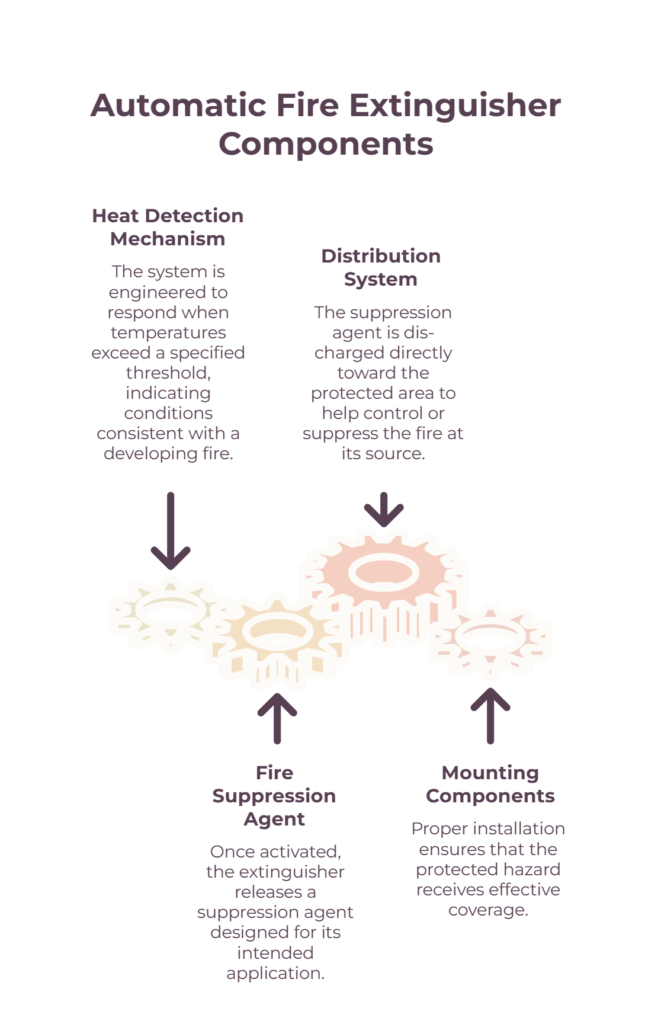
Heat Detection Mechanism
The system is engineered to respond when temperatures exceed a specified threshold, indicating conditions consistent with a developing fire.
Fire Suppression Agent
Once activated, the extinguisher releases a suppression agent designed for its intended application. Different systems may use clean agents, dry chemicals, foam, or other approved extinguishing media depending on the fire risk they are designed to address.
Distribution System
The suppression agent is discharged directly toward the protected area to help control or suppress the fire at its source.
Mounting Components
Proper installation ensures that the protected hazard—such as an engine compartment, electrical enclosure, or cooking area—receives effective coverage.
Where Are Automatic Fire Extinguishers Used?
Automatic fire extinguishers are suitable for a wide range of environments where early fire suppression is important.
Residential Applications
- Home kitchens
- LPG cylinder areas
- Electrical distribution boards
- Garages
- Utility rooms
Commercial Applications
- Restaurants
- Hotels
- Cloud kitchens
- Offices
- Retail stores
- Shopping centres
Industrial Applications
- Factories
- Manufacturing plants
- Warehouses
- Generator rooms
- Electrical control panels
- Machinery enclosures
Vehicle Applications
- Passenger cars
- SUVs
- Trucks
- Buses
- Construction equipment
- Agricultural machinery
Selecting the appropriate system depends on the specific fire hazards, the environment, and the applicable safety standards.
Common Fire Hazards Addressed
Automatic fire extinguishers are commonly used to help protect against:
- Kitchen fires
- LPG cylinder-related fire risks
- Electrical equipment overheating
- Engine compartment fires
- Generator fires
- Machinery fires
- Storage area fires
- Commercial cooking hazards
The suitability of a particular extinguisher depends on the class of fire and the manufacturer’s specifications.
Benefits of Early Fire Suppression
Early intervention can significantly reduce the impact of a fire.
Potential benefits include:
- Limiting fire spread
- Reducing property damage
- Improving occupant safety
- Minimizing business interruption
- Helping protect valuable equipment
- Supporting broader fire safety plans
Automatic systems are most effective when used as part of a comprehensive fire protection strategy that includes risk assessments, alarms, emergency procedures, and appropriate maintenance.
Key Takeaway: Automatic fire extinguishers provide continuous protection by responding automatically to excessive heat, making them valuable for areas where immediate human intervention may not be possible.
How Does an Automatic Fire Extinguisher Work?
An automatic fire extinguisher operates by monitoring heat within its protected area. When the activation temperature specified by the manufacturer is reached, the system automatically releases a fire suppression agent to help control or extinguish the fire in its early stages.
The Four-Step Fire Suppression Process
Understanding the process helps explain why automatic systems are effective for unattended risks.
Step 1: Heat Builds Up
A developing fire causes the surrounding temperature to rise. In locations such as kitchens, electrical panels, or engine compartments, this increase may occur rapidly.
Step 2: Activation
When the system reaches its designed activation threshold, it automatically triggers without requiring manual operation.
Step 3: Suppression Agent Release
The extinguisher discharges its suppression agent directly into the protected area. The type of agent and discharge pattern depend on the system design and intended application.
Step 4: Fire Suppression
The suppression agent helps interrupt the combustion process by cooling, smothering, or otherwise suppressing the fire, depending on the extinguishing medium used. This can reduce the fire’s intensity and help prevent further spread.
Why Early Activation Matters
The earliest stages of a fire often determine its eventual impact. By acting before flames spread extensively, automatic systems can help:
- Reduce heat buildup.
- Limit smoke production.
- Protect nearby equipment.
- Slow fire growth.
- Provide additional time for evacuation and emergency response.
Protecting people and property begins with proactive planning. If you’re evaluating automatic fire protection for your home, vehicle, commercial kitchen, or industrial facility, consider a professional fire safety assessment to determine the most appropriate solution for your specific risks.
Frequently Asked Questions
1. What is an automatic fire extinguisher?
An automatic fire extinguisher is a fire protection device that activates on its own when it detects a predetermined temperature, releasing a fire suppression agent to help control or extinguish a fire in its early stages without requiring manual operation.
2. How does an automatic fire extinguisher work?
An automatic fire extinguisher monitors heat in the protected area. When the activation temperature is reached, it automatically discharges a fire suppression agent to suppress the fire before it spreads significantly.
3. Can an automatic fire extinguisher save lives?
An automatic fire extinguisher can improve safety by helping control a fire in its early stages, reducing smoke, heat, and flame spread. While no device can guarantee safety in every situation, early suppression can provide valuable time for evacuation and emergency response.
4. Where should an automatic fire extinguisher be installed?
Installation depends on the fire risk. Common locations include kitchens, LPG cylinder areas, electrical panels, engine compartments, generator rooms, warehouses, commercial kitchens, factories, and server rooms. Follow the manufacturer’s installation instructions and applicable fire safety standards.
5. Is an automatic fire extinguisher suitable for home use?
Yes. Automatic fire extinguishers are commonly used in residential kitchens, utility areas, garages, and near electrical panels where early fire detection and suppression can provide additional protection.
6. Can I install an automatic fire extinguisher above a gas cylinder?
Gas Cylinder AFE are specifically designed for LPG cylinder protection. Installation should always follow the manufacturer’s guidance to ensure appropriate coverage and safe operation.
7. Is an automatic fire extinguisher suitable for vehicles?
Yes. Car automatic fire extinguishers are designed for engine compartments in cars, trucks, buses, and commercial vehicles. The correct system should be selected based on the vehicle type and operating conditions.
8. How is an automatic fire extinguisher different from a manual extinguisher?
A manual extinguisher requires a person to detect the fire and operate the equipment. An automatic fire extinguisher activates independently when its designed activation conditions are met, making it useful for unattended areas.
9. Do BrandsDaddy Automatic Fire Extinguishers require maintenance?
BrandsDaddy AFE is designed to be a low-maintenance fire safety solution. Under normal operating conditions, it does not require routine servicing during its warranty period. Instead, the unit should be replaced once its warranty or recommended service life expires, or immediately if it has been activated or shows signs of damage. Always follow the product instructions and warranty terms provided by BrandsDaddy.
10. Is an automatic fire extinguisher worth buying?
The value depends on your specific fire risks. For areas such as kitchens, engine compartments, electrical panels, or commercial facilities where fires may begin unnoticed, an automatic fire extinguisher can provide an additional layer of protection as part of a comprehensive fire safety plan.


Pingback: Automatic Fire Extinguisher for Cars: Complete Guide to Vehicle Fire Safety in India - Brandsdaddy