A fire can start in seconds. The real question is: what happens in those first few moments?
A conventional manual fire extinguisher depends on someone being present, noticing the fire, reaching the extinguisher and operating it correctly. An automatic fire extinguisher or automatic fire protection device is designed to respond to a fire without requiring the same immediate human action.
That difference can become especially important in places that are unattended, difficult to access, or exposed to specific fire hazards.
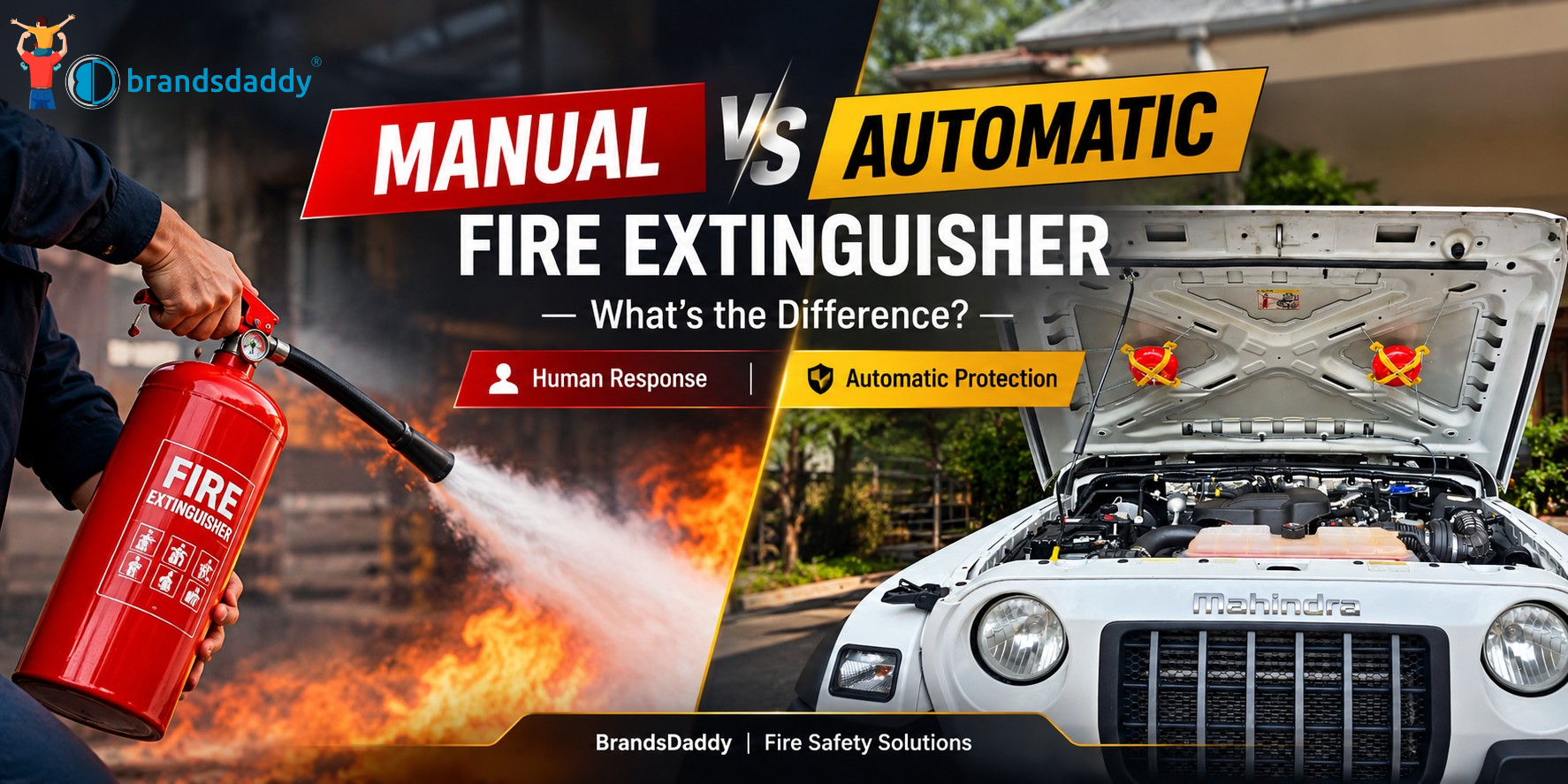
So, manual vs automatic fire extinguisher — what is the difference, how do they work, and where should each be used?
This guide explains the difference in simple terms and helps you understand where manual fire extinguishers, automatic fire extinguishers and broader fire suppression systems fit into a practical fire-safety strategy in India.
Manual vs Automatic Fire Extinguisher: Quick Answer
The simplest difference is who or what initiates the firefighting response.
A manual fire extinguisher requires a person to identify the fire and operate the extinguisher.
An automatic fire extinguisher is designed to activate automatically when its triggering mechanism detects conditions associated with a fire, depending on the product design.
| Feature | Manual Fire Extinguisher | Automatic Fire Extinguisher |
|---|---|---|
| Activation | Person-operated | Automatic triggering mechanism |
| Human intervention | Required to activate | Not required for initial activation |
| Works when nobody is present | No, unless another automatic system is present | Can provide protection in unattended conditions, subject to product design |
| Response | Depends on detection and human reaction | Designed for automatic response |
| Typical use | General portable fire protection | Additional protection for specific fire-risk areas |
| Mobility | Usually portable | Often installed at a designated risk point |
| Best suited for | Areas where people are present and can respond | Equipment, vehicles, enclosed or unattended risk areas, depending on design |
| Human response after activation | Often required for evacuation/emergency management | Still necessary for evacuation and emergency response |
The important point is that automatic does not mean “no fire-safety planning is required.” Fire extinguishers and fire-protection systems must still be selected according to the hazard, occupancy, environment and applicable standards. BIS guidance specifically states that extinguisher selection should consider the expected fire, property construction and occupancy, hazard, ambient temperature and other relevant factors.
What Is a Manual Fire Extinguisher?
A manual fire extinguisher is a portable firefighting device that requires a person to operate it.
The basic sequence is familiar:
Detect the fire → pick up the extinguisher → operate it → direct the extinguishing agent at the fire.
BIS educational material describes the basic extinguisher-use sequence as pulling the pin, aiming the nozzle, squeezing the handle and sweeping from side to side at the base of the fire.
Manual fire extinguishers are commonly installed in:
- Homes
- Offices
- Shops
- Schools and colleges
- Hospitals
- Hotels and restaurants
- Warehouses
- Factories
- Commercial buildings
- Housing societies
- Vehicles
- Workshops
The exact extinguisher type should depend on the fire hazard. For example, different extinguishing agents are used for different classes of fire.
The limitation of a manual fire extinguisher
The biggest limitation is straightforward:
Someone has to be there to use it.
If a fire starts in an empty room, closed electrical area, parked vehicle, machinery enclosure or an otherwise unattended location, a manual extinguisher cannot act by itself.
That is where automatic fire protection can add another layer.
What Is an Automatic Fire Extinguisher?
An automatic fire extinguisher is designed to respond to fire conditions without requiring a person to manually operate the extinguisher at the moment the fire starts.
Depending on the technology, activation may be triggered by factors such as heat or another fire-detection mechanism.
The basic concept is:
Fire develops → triggering mechanism responds → extinguishing agent is released → fire is controlled or suppressed.
Automatic fire protection can therefore be particularly useful where a fire could develop before someone notices it.
This does not mean every automatic fire extinguisher works in exactly the same way. Different products use different activation mechanisms, extinguishing agents, capacities and installation methods.
Therefore, the product’s technical specifications and approved application should always be checked before installation.
Manual vs Automatic Fire Extinguisher: How Do They Work?
How a Manual Fire Extinguisher Works
A conventional portable extinguisher generally remains ready for a person to operate.
When someone notices a fire:
- They identify the fire.
- They access the appropriate extinguisher.
- They activate it.
- They aim at the appropriate part of the fire.
- They discharge the extinguishing agent.
- They continue responding while following emergency procedures.
This makes human detection and reaction an important part of the protection chain.
How an Automatic Fire Extinguisher Works
An automatic extinguisher is designed to remove or reduce that initial human-activation dependency.
When the fire reaches the activation condition specified for the device, the automatic mechanism activates and releases the extinguishing agent.
This can provide an important advantage in locations where:
- Nobody may be present.
- Fire could start behind or inside equipment.
- A small fire could grow rapidly.
- Access to the fire may be difficult.
- Continuous automatic protection is desirable.
Automatic fire protection should be considered an additional layer of fire safety, not a replacement for evacuation procedures, alarms, appropriate portable extinguishers or other required fire-protection systems.
Manual vs Automatic Fire Extinguisher: Key Differences
1. Human Intervention
This is the biggest difference.
A manual extinguisher requires a person to detect the fire and operate the device.
An automatic extinguisher is designed to activate automatically when its specified triggering condition is reached.
For a fire that begins when a room, vehicle or facility is unattended, this difference can matter significantly.
2. Response Dependency
With a manual extinguisher, response depends on a chain of events:
Fire → detection → human reaction → access → operation
With an automatic device, the initial response can be:
Fire → automatic activation
The exact activation and discharge characteristics depend on the technology and product.
3. Protection When People Are Away
Manual extinguishers are highly dependent on people being available to use them.
Automatic fire extinguishers can provide another layer of protection in locations that may be unattended.
This is one reason automatic fire protection is considered for areas such as equipment compartments, vehicles, machinery areas and other specific hazards.
4. Ease of Immediate Response
A manual extinguisher can be very useful when a trained person is nearby and can respond quickly.
However, the effectiveness of that response depends on the person’s ability to:
- Notice the fire
- Reach the extinguisher
- Select the appropriate extinguisher
- Operate it correctly
- Maintain a safe position
- Know when to stop and evacuate
Automatic protection reduces the dependence on that first human action.
Are Automatic Fire Extinguishers Better Than Manual Fire Extinguishers?
This is not necessarily an either-or decision.
Manual and automatic fire extinguishers serve different roles.
A manual extinguisher gives people a way to respond to an identified fire.
Automatic protection provides an additional response mechanism that can operate without waiting for someone to manually activate the device.
For many properties, the more practical approach is layered fire protection.
That can include:
Fire prevention + detection + alarm + manual firefighting equipment + automatic fire protection + evacuation planning
The appropriate combination depends on the building, occupancy, fire hazards and applicable requirements.
BIS’s current guidance for first-aid fire extinguishers emphasizes selecting equipment according to the specific hazard and fire class rather than treating every location the same.
Where Can Manual Fire Extinguishers Be Used?
Manual fire extinguishers remain an essential part of fire safety.
They can be positioned in accessible locations such as:
Homes
For kitchens, electrical areas, garages and other identified risks.
Offices
For electrical equipment, pantry areas and general workplace hazards.
Shops and Commercial Buildings
For accessible first-response firefighting.
Factories
For machinery, electrical and process-related hazards, depending on the risk assessment.
Warehouses
For storage areas and other identified fire hazards.
Schools and Colleges
For accessible emergency response equipment.
Hotels and Restaurants
For kitchens, electrical areas and other applicable hazards.
Vehicles
For vehicle-specific fire risks, where an appropriate extinguisher is selected and installed correctly.
Where Can Automatic Fire Extinguishers Provide Extra Protection?
Automatic fire extinguishing devices can be particularly useful for specific, localized or unattended fire risks, depending on their design.
Potential applications may include:
- Vehicle compartments
- Machinery
- Electrical equipment
- Control panels
- Small enclosed equipment areas
- Industrial equipment
- Storage areas
- Commercial premises
- Residential areas
- Areas where a fire could develop when people are absent
The correct application depends on the product’s extinguishing agent, activation mechanism, installation requirements and the hazard being protected.
For larger facilities, automatic protection may also take the form of engineered systems such as sprinklers, water-mist systems, gaseous suppression systems, foam systems or other specialized fire suppression technologies. These are different from a portable extinguisher and should not be treated as interchangeable products.
Automatic Fire Extinguisher vs Fire Suppression System
These terms are often used interchangeably online, but they are not necessarily the same thing.
An automatic fire extinguisher may refer to a self-contained device designed to automatically discharge an extinguishing agent when activated.
A fire suppression system is generally a broader engineered installation designed around a particular hazard or protected area.
For example, fire suppression systems can include:
- Automatic sprinkler systems
- Water-mist systems
- Clean-agent systems
- CO₂ systems
- Foam systems
- Wet-chemical systems
- Dry-chemical systems
The right technology depends on what is being protected and the type of fire risk involved.
For example, BIS guidance specifically notes that clean-agent extinguishers may be selected where a clean medium is necessary to extinguish a fire without damaging equipment or creating additional hazards.
Why Automatic Fire Protection Matters
Fire does not follow business hours.
A fire can start:
- At night
- During holidays
- In an empty office
- In a parked vehicle
- Inside machinery
- Near electrical equipment
- In a storage area
- When workers are away from a particular location
This is where automatic fire protection can provide an additional safety layer.
The objective is simple:
Detect and respond to fire as early as possible, before a small incident has more opportunity to develop into a larger emergency.
For high-risk or complex properties, automatic protection may form part of a larger fire-safety strategy rather than being used as a standalone solution.
Manual vs Automatic Fire Extinguisher: Which One Should You Choose?
Instead of asking only “manual or automatic?”, ask:
1. What type of fire risk exists?
Is the risk mainly:
- Ordinary combustible materials?
- Electrical equipment?
- Flammable liquids?
- Cooking oil?
- Machinery?
- Vehicle-related?
- LPG or gas-related?
- Industrial processes?
The extinguishing method should match the hazard.
2. Will someone always be present?
If trained people are normally present, manual firefighting equipment is an important part of first-response protection.
If the area may remain unattended, automatic protection can provide an additional layer.
3. How quickly can the fire grow?
Some hazards can escalate rapidly.
The greater the potential for rapid fire development, the more important early detection and appropriate automatic protection can become.
4. Is the area difficult to access?
If reaching the fire quickly could be difficult, localized automatic protection may be worth considering.
5. What do applicable standards require?
Fire-protection requirements can vary according to building type, occupancy, hazard and jurisdiction.
For India, equipment selection and installation should be checked against applicable BIS standards and local fire-safety requirements. BIS currently lists IS 2190:2024 as the code of practice for selection, installation and maintenance of first-aid fire extinguishers.
Can an Automatic Fire Extinguisher Replace a Manual Fire Extinguisher?
Not necessarily.
Automatic and manual fire extinguishers address different parts of the fire-response process.
An automatic device can provide protection when a person is not immediately available.
A manual extinguisher allows a trained person to respond to a fire that has been detected.
In many environments, these approaches can complement each other.
Think of it as layers:
Automatic protection + manual firefighting equipment + fire alarm + evacuation plan + regular inspection
Rather than relying on a single product, a complete fire-safety strategy considers the entire risk.
Manual vs Automatic Fire Extinguisher for Indian Homes
For homes, the answer depends on the specific risks.
A household may have:
- LPG or gas appliances
- Electrical equipment
- Kitchen cooking risks
- Inverters and batteries
- Cars or two-wheelers
- Garages or storage areas
A suitable manual extinguisher can provide first-response capability.
Automatic fire protection can provide additional protection in selected locations where a fire could start and develop without immediate human attention.
The important principle is to match the fire protection equipment to the actual hazard.
Manual vs Automatic Fire Extinguisher for Cars
Vehicles present a different challenge.
A car may be parked outside a home, office or commercial building with nobody nearby. If a fire develops when the vehicle is unattended, a conventional manual extinguisher cannot activate itself.
An automatic fire extinguisher designed for vehicle applications can provide an additional layer of protection by responding automatically when its specified activation condition is reached.
For vehicle fire safety, the product must be suitable for the intended application and installed according to its manufacturer’s instructions.
Manual vs Automatic Fire Extinguisher for Businesses
Businesses often need multiple layers of fire protection.
Depending on the property and risk profile, this may include:
- Portable fire extinguishers
- Fire alarm systems
- Emergency lighting
- Fire detection
- Sprinkler systems
- Hydrant systems
- Automatic suppression
- Fire exits
- Emergency evacuation procedures
- Employee fire-safety training
The National Building Code framework and applicable Indian Standards provide guidance for fire safety depending on building occupancy and characteristics. BIS’s fire-safety resources cover fire extinguishers and broader fire-protection standards.
The Bigger Picture: Automatic Fire Protection
The biggest advantage of automatic fire protection is not simply the word “automatic.”
It is the reduction of dependence on the first human response.
A strong fire-safety strategy asks:
What happens if nobody is there?
What happens if the fire starts at night?
What happens if the person who sees it is not trained?
What happens if the fire is inside equipment or a vehicle?
These questions help identify where automatic fire protection can add value.
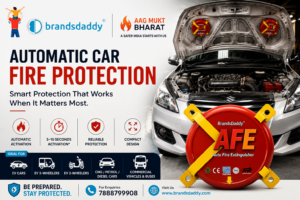
BrandsDaddy AFE: Automatic Protection for an Additional Layer of Safety
BrandsDaddy’s Automatic Fire Extinguisher (AFE) is designed around a simple idea:
Protection that doesn’t wait for you to react.
Unlike a conventional manual extinguisher that requires someone to notice a fire and operate the extinguisher, an automatic fire extinguisher is designed to provide automatic response when its activation mechanism reaches the specified condition.
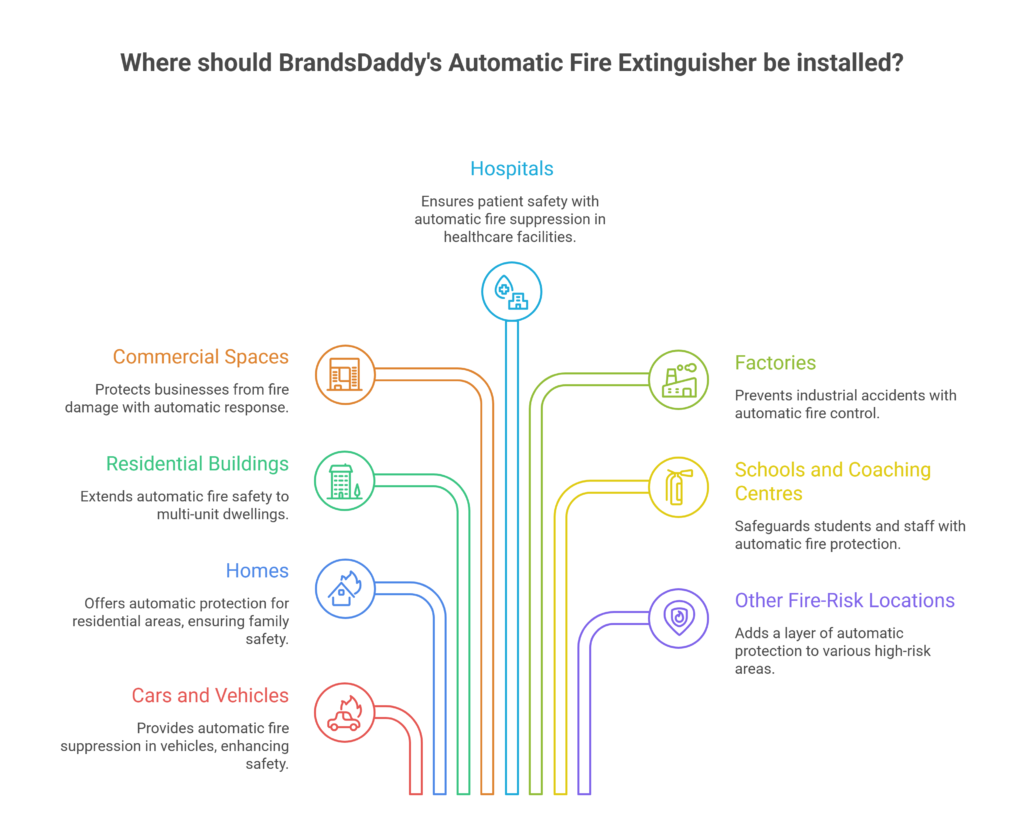
BrandsDaddy AFE is positioned for applications including:
- Cars and vehicles
- Homes
- Residential buildings
- Commercial spaces
- Hospitals
- Factories
- Schools and coaching centres
- Other suitable fire-risk locations
For product-specific applications, installation instructions and operating characteristics, users should always refer to the product information and technical specifications provided by BrandsDaddy.
The goal is not to replace every existing fire-safety measure. It is to add another layer of protection where automatic response can make a difference.
Frequently Asked Questions About Manual vs Automatic Fire Extinguishers
What is the difference between a manual and automatic fire extinguisher?
A manual fire extinguisher requires a person to detect the fire and operate the device. An automatic fire extinguisher is designed to activate automatically when its specified triggering condition is reached.
Does an automatic fire extinguisher need a person to activate it?
The purpose of an automatic extinguisher is to activate without requiring someone to manually operate it at the moment of fire activation. The exact mechanism depends on the product.
Can an automatic fire extinguisher work when nobody is present?
An appropriately designed automatic fire extinguisher can provide automatic fire response in an unattended area, subject to its application, installation and activation mechanism.
Is an automatic fire extinguisher better than a manual extinguisher?
They serve different purposes. A manual extinguisher provides human-operated first-response protection, while automatic protection can provide an additional response layer without waiting for manual activation.
Can I use both manual and automatic fire extinguishers?
Yes. They can form complementary layers of fire protection when selected and installed appropriately.
Where should an automatic fire extinguisher be installed?
Installation depends on the product, hazard and protected area. Possible applications include vehicles, machinery, equipment and other specific fire-risk locations.
Are automatic fire extinguishers suitable for homes?
They can be considered for appropriate residential applications, especially where an additional layer of automatic protection is desired. The correct product should be selected according to the specific fire hazard.
Are automatic fire extinguishers suitable for cars?
Certain automatic fire-protection products are designed for vehicle applications. The product must be appropriate for the vehicle and installed according to the manufacturer’s instructions.
Is a fire extinguisher enough for complete fire safety?
No single device should be treated as a complete fire-safety strategy. Depending on the property, effective fire safety can involve prevention, detection, alarms, extinguishers, suppression systems, evacuation planning and training.
Final Takeaway
The difference between a manual fire extinguisher and an automatic fire extinguisher comes down to one fundamental factor:
Who starts the firefighting response?
A manual extinguisher depends on a person.
An automatic fire extinguisher is designed to respond automatically when its specified activation condition is reached.
For modern fire safety, the question should not always be “manual or automatic?”
A better question is:
“Where does my property need human response, and where could automatic protection provide an additional layer of safety?”
From homes and vehicles to factories, warehouses, offices and commercial properties, understanding that difference can help you build a more complete fire-protection strategy.
When fire safety matters, protection should be designed around the risk — not just the equipment.
Explore automatic fire protection solutions from BrandsDaddy and identify the right solution for your application.