
The kitchen is one of the busiest parts of any home.
It’s where we make our morning chai, prepare meals for the family, fry snacks on weekends, and sometimes rush through cooking when we’re already late.
Because cooking is such a normal part of everyday life, kitchen fire safety is easy to overlook.
But think about what is actually happening in a kitchen.
You have an LPG cylinder, an open flame, cooking oil, electrical appliances, hot utensils and plenty of things that can burn—all working together in a relatively small space.
And sometimes, it takes only one small mistake.
A pan of oil is left unattended.
A kitchen towel gets too close to the burner.
An LPG hose is damaged but ignored.
A gas leak goes unnoticed.
Or someone throws water on a burning pan of oil, making the situation much worse.
A kitchen fire can go from a small flame to a serious emergency in a matter of seconds.
The good news is that many of these risks are preventable.
A few simple habits—such as keeping the LPG installation in good condition, staying near the stove while cooking, keeping flammable materials away from heat and knowing what to do during a gas leak—can make a significant difference.
But there is another question that every homeowner, restaurant owner and commercial kitchen operator should ask:
What happens if a fire starts when nobody is there to notice it?
That’s where having an additional layer of automatic fire protection can become important.
A Gas Cylinder AFE (Automatic Fire Extinguisher) is designed to provide automatic fire protection for suitable gas-cylinder/LPG installations, helping reduce reliance on immediate human intervention when a fire occurs.
In this complete guide, we’ll look at the most common kitchen fire safety mistakes, how to prevent LPG and cooking fires, what to do if you smell gas, why some common firefighting responses can actually make a fire worse, and how a Gas Cylinder AFE can fit into a broader kitchen fire-safety strategy.
Let’s start with the basics.
What Causes Kitchen Fires?
Kitchen fires generally happen when heat, fuel and an ignition source come together under unsafe conditions.
Some of the most common kitchen fire hazards include:
- LPG gas leaks
- Damaged or improperly fitted LPG hoses
- Unattended cooking
- Overheated cooking oil
- Oil or grease coming into contact with flames
- Flammable materials kept near the stove
- Electrical faults
- Faulty kitchen appliances
- Poor ventilation
- Unsafe LPG storage
- Human error
The important thing to remember is that fire safety isn’t about assuming a fire will happen.
It’s about reducing the chances of one happening—and being prepared if prevention fails.
Common Kitchen Fire Safety Mistakes to Avoid
1. Leaving Cooking Unattended
This is probably one of the easiest kitchen mistakes to make.
You put something on the stove and think:
“I’ll just step out for two minutes.”
Then the phone rings.
Someone calls you.
The doorbell rings.
You start doing something else.
Those two minutes can be enough for oil to overheat, milk to boil over, food to burn or a pan to catch fire.
Fire-safety guidance recommends staying in the kitchen while frying or cooking with oil and turning off the burner if you leave.
A safer habit
Stay near the stove while cooking, especially when:
- Deep frying
- Heating oil
- Cooking at high temperatures
- Using multiple burners
- Preparing food that needs regular attention
If you need to leave, switch off the burner when it is safe to do so.
Don’t give a small kitchen fire the head start it needs.
2. Ignoring the Smell of LPG
If you smell LPG in your kitchen, don’t ignore it.
Don’t assume:
“Maybe it’s just the cylinder.”
Or:
“The smell will go away.”
A gas smell can indicate a leak and needs to be treated seriously.
Official LPG safety guidance recommends closing the regulator and burner knobs, ventilating the area, extinguishing flames and avoiding electrical switches when LPG leakage is suspected.
If you smell LPG:
Do:
- Close the regulator if it is safe to do so.
- Turn off the burner knobs.
- Extinguish open flames.
- Open doors and windows for ventilation.
- Move people away from the affected area.
- Contact your LPG distributor or emergency support.
Don’t:
- Light a match.
- Use a lighter.
- Smoke.
- Switch electrical appliances on or off.
- Try to locate the leak using a flame.
- Attempt an unsafe DIY repair.
In India, the official LPG emergency helpline is 1906.
3. Checking an LPG Leak With a Matchstick
This deserves special attention.
Never use a matchstick or lighter to check whether your LPG connection is leaking.
It may sound like an old practice, but it is extremely dangerous.
If LPG has accumulated, introducing a flame can ignite it.
Instead, follow the safety instructions provided by your LPG distributor and get the installation checked by an authorized professional when necessary.
The official LPG safety guidance specifically warns against using a lighted matchstick to check for gas leaks.
When it comes to LPG:
If you’re unsure, don’t experiment.
4. Keeping the LPG Cylinder in an Enclosed Cabinet
Modern kitchens are often designed to look clean and minimal.
So it’s tempting to hide the LPG cylinder inside a cabinet.
But an LPG cylinder isn’t ordinary kitchen storage.
Official LPG guidance recommends keeping the cylinder upright, at an appropriate ground-level location, and not inside an enclosed compartment or below floor level. It also recommends keeping the stove on a platform above cylinder level.
The cylinder should also remain accessible for inspection and safe handling.
Avoid:
- Keeping the cylinder horizontally
- Placing it in a pit below floor level
- Sealing it inside an unsuitable cabinet
- Keeping unnecessary combustible materials around it
- Exposing it to unnecessary heat
When it comes to LPG, safety should come before aesthetics.
5. Keeping Flammable Items Too Close to the Stove
Take a quick look around your stove.
Is there a kitchen towel hanging nearby?
A plastic packet?
A newspaper?
A cardboard box?
A curtain?
These things may seem harmless until they come into contact with enough heat or flame.
Fire-safety guidance recommends keeping items that can catch fire—such as towels, packaging, curtains and utensils—away from cooking surfaces and other heat sources.
Keep the area around your stove as clear as possible.
A simple rule is:
If it can burn, don’t keep it unnecessarily close to the flame
6. Wearing Loose Clothing While Cooking
This is particularly relevant in Indian kitchens where dupattas, loose sleeves and flowing garments are common.
Loose clothing can accidentally come into contact with a gas flame.
Official LPG guidance recommends suitable clothing while cooking, including cotton garments, and advises using proper pot holders rather than clothing to handle hot cookware.
Better practice:
- Tie back long hair.
- Avoid loose sleeves near the stove.
- Keep dupattas and scarves away from flames.
- Use proper pot holders.
- Avoid highly flammable fabrics around open flames.
It’s a small precaution, but it can prevent a very serious accident.
7. Pouring Water on a Cooking-Oil Fire
Imagine a pan of oil suddenly catches fire.
Your first instinct may be:
“Paani daalo!”
Don’t.
Water should not be poured onto a cooking-oil or grease fire.
Water can cause burning oil to spread rapidly and create a dangerous fireball or splashing hazard.
NFPA guidance specifically advises never pouring water onto a grease fire. For a small pan fire, its guidance recommends covering the pan with a suitable lid, turning off the burner and leaving the pan covered until it cools—provided it can be done safely.
If a small pan fire occurs:
- Don’t panic.
- Don’t move the pan.
- If safe, turn off the burner.
- If appropriate and safe, cover the pan with a lid.
- Leave the lid in place while the pan cools.
- If the fire grows or you cannot control it safely, evacuate.
Never put your life at risk trying to save a pan of oil.
8. Forgetting to Switch Off the LPG Regulator
Here’s one habit that takes only a few seconds.
After cooking:
Burner OFF.
Regulator OFF.
Kitchen checked.
Official LPG safety guidance specifically recommends switching off the regulator when it isn’t in use, including before going to bed.
Make it part of your routine.
Especially at night, take those extra few seconds to make sure the LPG installation has been safely shut down.
9. Trying to Repair LPG Equipment Yourself
Your LPG hose looks damaged.
The connection feels loose.
The regulator doesn’t seem to be working correctly.
It can be tempting to think:
“I’ll fix it myself.”
Don’t.
Official LPG guidance states that self-repair is unsafe and recommends getting the installation checked by an authorized mechanic.
If you notice:
- A damaged hose
- Loose connections
- A faulty regulator
- Persistent gas smell
- Visible damage
- Anything unusual around the LPG setup
stop using the installation if it is safe to do so and contact the appropriate authorized service provider.
Gas safety isn’t the place to experiment.
10. Ignoring the LPG Hose
Most people remember to look at the cylinder.
Most people remember to look at the stove.
But the hose connecting them?
That can easily get overlooked.
The LPG hose is an important part of the installation and should be kept visible and in good condition.
Check for:
- Cracks
- Cuts
- Wear
- Damage
- Loose connections
- Improper positioning
- Exposure to excessive heat
Current official LPG guidance also highlights the use of approved Suraksha LPG hoses and notes that old or unsuitable hoses can be a safety concern.
If something looks damaged or abnormal, get it checked rather than waiting for it to become a problem.
11. Storing Things Above or Around the Cooking Area
Kitchens often have shelves and cabinets directly above the stove.
But the area around a cooking flame shouldn’t become a storage zone for random items.
Avoid keeping easily combustible items close to heat sources.
Official LPG safety guidance also advises against placing storage cabinets or shelves above the hot plate where reaching for items could create an accident.
Keep the cooking area practical, accessible and uncluttered.
12. Assuming Someone Will Always Be There to Handle a Fire
This is perhaps the biggest mistake of all.
We often think:
“Aag lagegi toh dekh lenge.”
But what if nobody is in the kitchen?
What if everyone is sleeping?
What if you’re at work?
What if the kitchen belongs to a restaurant and the employee has stepped away?
A fire doesn’t wait for someone to notice it.
That’s why good fire protection works in layers.
Prevention is one layer.
Detection is another.
Manual firefighting equipment is another.
And where appropriate, automatic fire protection can provide an additional layer.
What Is a Gas Cylinder AFE?
A Gas Cylinder AFE means a Gas Cylinder Automatic Fire Extinguisher.
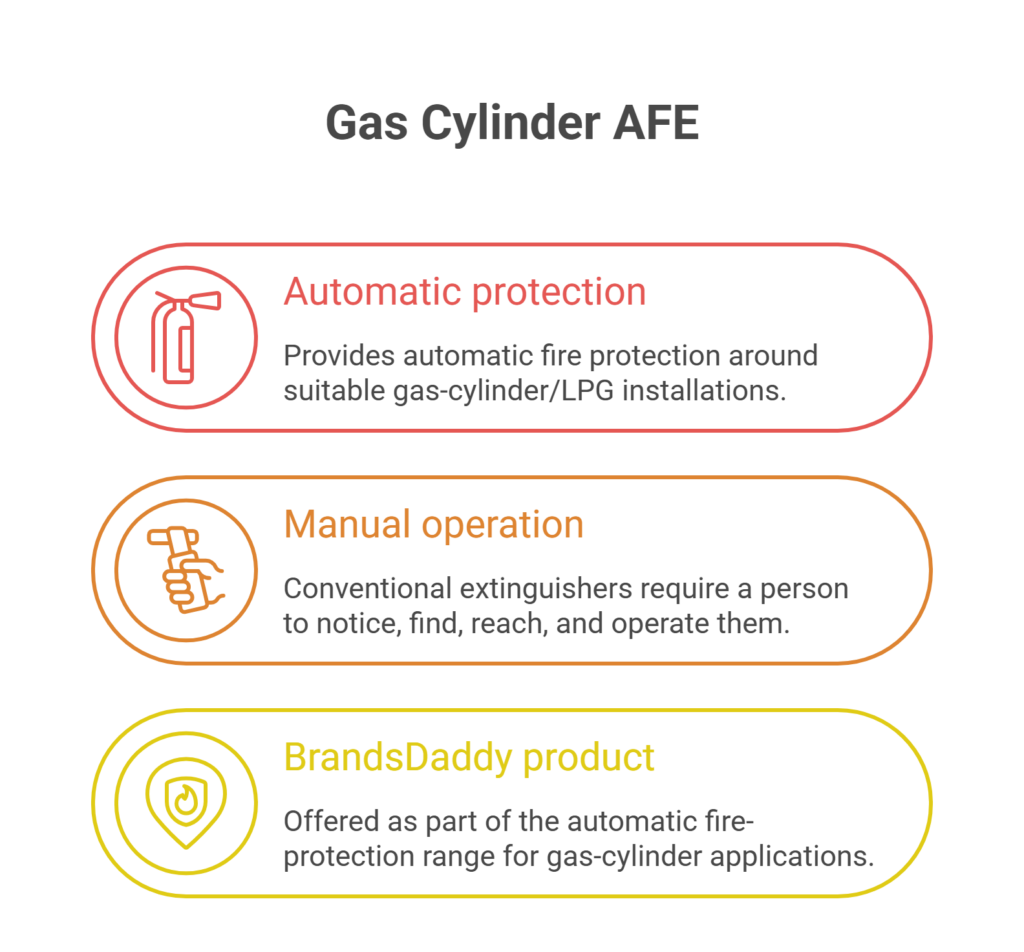
It is designed to provide automatic fire protection around suitable gas-cylinder/LPG installations.
The concept is straightforward.
A conventional fire extinguisher generally requires a person to:
- Notice the fire.
- Find the extinguisher.
- Reach the fire.
- Operate the extinguisher correctly.
An automatic fire-protection product is designed to provide protection without relying entirely on someone being immediately present to manually activate it.
BrandsDaddy offers a Gas Cylinder AFE as part of its automatic fire-protection range for gas-cylinder applications.
For current product specifications, suitability, installation requirements and warranty information, refer to the official product information from BrandsDaddy.
Explore BrandsDaddy Automatic Fire Extinguisher
How Does a Gas Cylinder AFE Help With Kitchen Fire Safety?
The idea behind automatic fire protection is particularly relevant to areas where a fire can start when people aren’t immediately present.
For example:
It’s 2 AM.
Everyone is asleep.
The kitchen is empty.
Something goes wrong around the LPG installation.
There is nobody standing next to the cylinder with a fire extinguisher.
This is where an automatic protection layer can make a difference.
A Gas Cylinder AFE is designed to respond automatically when its specified activation conditions are reached, depending on the product and installation.
That doesn’t mean it replaces responsible LPG use.
It means you’re adding another layer of protection.
And that’s an important distinction.
Automatic fire protection works best as part of a complete fire-safety strategy—not as a replacement for one.
Can a Gas Cylinder AFE Replace a Regular Fire Extinguisher?
No. A Gas Cylinder AFE and a manual fire extinguisher can serve different purposes.
A comprehensive kitchen fire-safety plan may include:
- Safe LPG installation
- Proper ventilation
- Approved LPG components
- Regular inspection
- Suitable manual fire extinguishers
- Automatic fire protection where appropriate
- Fire detection where suitable
- Emergency procedures
- Family or staff awareness
Think of fire protection like layers of security.
If one layer doesn’t stop the problem, another layer may help.
Gas Cylinder AFE vs Traditional Fire Extinguisher
| Feature | Traditional Fire Extinguisher | Gas Cylinder AFE |
|---|---|---|
| Human intervention | Generally required | Designed for automatic activation |
| Manual operation | Required | Automatic response, subject to product activation conditions |
| Useful when people are absent | Limited | Can provide an additional automatic protection layer |
| Main role | Manual emergency firefighting | Automatic fire protection around a suitable high-risk area |
| Installation | Depends on extinguisher type | Depends on product and installation requirements |
| Should be part of a broader safety plan? | Yes | Yes |
The two shouldn’t necessarily be viewed as competing products.
In many situations, they can complement each other.
Where Can a Gas Cylinder AFE Be Considered?
Depending on the product specifications and installation requirements, automatic gas-cylinder fire protection can be considered for suitable environments such as:
- Homes
- Apartments
- Restaurants
- Hotels
- Cafes
- Cloud kitchens
- Catering facilities
- Commercial kitchens
- Industrial canteens
- Other suitable LPG installations
The important point is suitability.
The correct fire-protection solution depends on the actual risk, layout, equipment and applicable safety requirements.
Always follow the manufacturer’s installation instructions and obtain professional guidance where required.
What If an LPG Cylinder Area Catches Fire?
This is not a situation to take lightly.
If you see a fire around an LPG cylinder:
First priority: people
Get everyone away from the danger area.
Don’t try to be a hero
If the fire is growing or you’re not trained to handle it, evacuate.
Don’t approach a cylinder unnecessarily
Heat exposure around LPG cylinders can create extremely dangerous conditions.
Don’t operate electrical switches if LPG leakage is suspected
Follow the official LPG emergency procedure.
Call for help
Use the appropriate emergency service/LPG emergency support.
Remember:
Property can be replaced. People cannot.
Kitchen Fire Safety Checklist
Use this quick checklist for your home or workplace kitchen.
LPG Safety
- Is the LPG cylinder upright?
- Is the cylinder in an appropriate, ventilated location?
- Is it accessible for inspection?
- Is the LPG hose in good condition?
- Are the connections secure?
- Is the stove positioned above cylinder level?
- Is the regulator switched off when the stove is not being used?
- Has the installation been inspected as recommended by the LPG provider?
Cooking Safety
- Do you stay near the stove while frying or cooking with oil?
- Are kitchen towels away from flames?
- Are curtains away from the stove?
- Are paper and plastic items away from heat?
- Are loose clothes kept away from flames?
- Are children kept away from the cooking area?
- Are hot utensils handled with proper pot holders?
Fire Protection
- Is an appropriate fire extinguisher available?
- Does everyone know where it is?
- Does everyone know what to do if LPG is leaking?
- Is automatic fire protection appropriate for your LPG installation?
- Are emergency contact numbers easily accessible?
Kitchen Fire Prevention: 7 Habits Worth Making Permanent
If you remember only seven things from this article, remember these:
1. Never leave cooking unattended
Especially when frying or cooking with oil.
2. Treat every LPG smell seriously
Don’t wait for it to disappear.
3. Never check an LPG leak with a flame
Use safe procedures and professional assistance.
4. Keep combustible items away from your stove
Towels, paper, packaging and curtains should not be close to flames.
5. Never throw water on a cooking-oil fire
Use an appropriate response for the type of fire.
6. Turn off the LPG regulator when not in use
Make it part of your daily routine.
7. Think about protection beyond human reaction
A suitable Gas Cylinder AFE can provide an additional automatic fire-protection layer around an appropriate LPG installation.
Kitchen Fire Safety Isn’t Only About Homes
When people hear “kitchen fire,” they usually think about their home.
But the same risks exist in commercial environments—and sometimes at a much larger scale.
Think about:
- Restaurants
- Hotels
- Cafes
- Cloud kitchens
- Catering businesses
- Food courts
- Factory canteens
- Office cafeterias
- Commercial kitchens
These kitchens may operate for many hours every day, with multiple burners, cooking oils, LPG installations and electrical equipment working simultaneously.
That makes a layered fire-safety strategy even more important.
For a commercial kitchen, fire protection should be based on the actual risk assessment and applicable requirements.
Automatic fire protection can be considered as one part of that broader strategy.
Why Early Fire Protection Matters
A small fire is generally easier to manage than a fire that has already spread.
Once flames involve surrounding materials, the situation can change quickly.
Smoke increases.
Heat increases.
Visibility decreases.
Escape becomes more difficult.
People panic.
That’s why good fire safety isn’t about waiting until there is a major emergency.
It’s about asking:
What can I do before the fire starts?
And then:
What protection do I have if prevention fails?
That’s where the idea of layered protection becomes important.
Fire Prevention + Fire Protection: The Better Approach
Think of kitchen fire safety as a chain.
Step 1: Prevent
Use LPG equipment correctly and eliminate avoidable hazards.
Step 2: Inspect
Check hoses, connections and other equipment.
Step 3: Detect
Use suitable detection systems where appropriate.
Step 4: Respond
Have suitable firefighting equipment available.
Step 5: Automate where appropriate
Consider automatic fire protection for suitable high-risk areas.
Step 6: Evacuate
If a fire becomes unsafe to control, get out.
This approach is much stronger than simply buying a fire extinguisher and putting it somewhere in the kitchen.
Frequently Asked Questions About Kitchen Fire Safety & Gas Cylinder AFE
What is a Gas Cylinder AFE?
A Gas Cylinder AFE is a Gas Cylinder Automatic Fire Extinguisher designed to provide an additional automatic fire-protection layer around suitable gas-cylinder/LPG installations.
How does a Gas Cylinder AFE work?
The exact mechanism depends on the product. An automatic fire extinguisher is designed to activate when its specified activation conditions are reached, providing an automatic response without relying entirely on someone manually operating an extinguisher.
Is a Gas Cylinder AFE useful for a home kitchen?
It can be considered as an additional layer of protection for an appropriate LPG installation. However, it should complement—not replace—safe LPG practices, suitable firefighting equipment and professional safety guidance.
Can a Gas Cylinder AFE replace a regular fire extinguisher?
No. A Gas Cylinder AFE and a manual fire extinguisher can have different roles. A comprehensive fire-safety plan may use multiple layers of protection.
What is the biggest kitchen fire safety mistake?
Leaving cooking unattended is one of the most common preventable risks. LPG leaks, combustible materials near flames and unsafe attempts to extinguish cooking-oil fires are other major concerns.
Can I use water to extinguish an oil fire?
No. Water should not be poured onto a cooking-oil or grease fire because it can cause the burning oil to spread.
What should I do if I smell LPG?
If it is safe, close the regulator and burner knobs, extinguish open flames, ventilate the area and avoid electrical switches. Contact your LPG distributor or emergency support. India’s LPG emergency helpline is 1906.
Can I check an LPG leak using a matchstick?
No. Never use a matchstick or lighter to check for an LPG leak. Official LPG guidance specifically warns against this practice.
Should an LPG cylinder be kept inside a kitchen cabinet?
An LPG cylinder should not be placed inside an unsuitable enclosed compartment. Follow the LPG provider’s installation and ventilation requirements. Official guidance recommends keeping the cylinder upright and not inside an enclosed compartment.
Should I switch off the LPG regulator after cooking?
Yes. Official LPG safety guidance recommends switching off the regulator when the stove is not in use.
Can I repair my LPG connection myself?
No. Self-repair is unsafe. If your LPG installation has a problem, contact an authorized mechanic or your LPG distributor.
How can I prevent kitchen fires?
Start with the basics: don’t leave cooking unattended, maintain your LPG installation, keep combustible materials away from flames, know how to respond to a gas leak and maintain appropriate fire-protection equipment.
What is an automatic gas fire extinguisher?
An automatic gas fire extinguisher is designed to provide automatic fire protection for suitable gas/LPG-related applications, depending on the product’s specifications and installation.
Is automatic fire protection better than a manual extinguisher?
They are not necessarily alternatives. Automatic and manual fire protection can complement each other. Automatic protection can provide another layer when people are not immediately present, while manual extinguishers remain important for appropriate emergency response.
Where can a Gas Cylinder AFE be installed?
It should be installed only in locations and applications for which the product is suitable, following the manufacturer’s installation instructions and applicable safety requirements.
Is kitchen fire safety important for restaurants?
Absolutely. Commercial kitchens can have prolonged cooking activity, multiple heat sources, LPG installations, cooking oil and electrical equipment. A proper fire-risk assessment and layered fire-protection strategy are important.
How often should an LPG installation be checked?
Follow the current guidance of your LPG provider and applicable requirements. The official PMUY safety pledge currently advises getting the LPG installation inspected by an authorized mechanic every five years.
Final Thoughts: Don’t Wait for a Fire to Teach You About Fire Safety
We usually think seriously about fire safety after something happens.
After seeing a fire on the news.
After hearing about an accident.
After a neighbour has a close call.
But fire safety works best when you think about it before the emergency.
So take a few minutes today.
Look at your kitchen.
Check the LPG hose.
Look at the cylinder position.
Move that towel away from the burner.
Clear the area around the stove.
Make sure your family knows what to do if they smell gas.
And then ask yourself one more question:
“If a fire starts in my kitchen when nobody is there, what protection do I have?”
That question is worth asking.
Because prevention is always the first priority—but when prevention fails, having another layer of protection can matter.
For suitable LPG installations, a Gas Cylinder AFE can be considered as one part of that additional protection strategy.
Because fire safety isn’t about expecting something bad to happen.
It’s about being prepared if it does.
Protect What Matters Before You Need Protection
If you’re looking for an additional automatic fire-protection solution for a suitable LPG/gas-cylinder installation, explore the BrandsDaddy Gas Cylinder AFE.
For current product specifications, installation requirements, suitability, warranty and other technical details, refer to the latest information from BrandsDaddy and consult a qualified professional where appropriate.
BrandsDaddy
When AFE is HERE, then why FEAR?