Automatic fire protection is changing how homes and businesses in India approach fire safety by providing an additional layer of protection where fires can start unexpectedly. From residential kitchens and LPG areas to vehicles, shops and commercial spaces, proactive fire protection can help address risks before they become major emergencies.
A fire can start in seconds. The right protection needs to be ready before it does.
Most people think about fire safety after witnessing a fire, hearing about an accident or receiving a safety warning. By then, the most valuable opportunity has already passed: preparing before the emergency.
At BrandsDaddy, we believe India needs to move from a reactive approach to a more proactive one.
That means looking beyond the conventional fire extinguisher and asking a more important question:
What happens when a fire starts and nobody is there to respond?
This question drives our work in automatic fire protection. It also connects with our broader Aag Mukt Bharat vision—to encourage greater fire awareness, stronger prevention and practical access to fire-protection solutions across India.
Why Fire Protection Needs to Reach Beyond Large Buildings
Fire safety often brings large factories, commercial complexes and industrial facilities to mind.
Yet a fire can begin in a home, neighbourhood shop, restaurant kitchen, workshop or parked vehicle just as easily. Electrical appliances, LPG systems, batteries, cooking equipment, machinery and fuel can all introduce potential fire risks into everyday environments.
India’s broader disaster-management framework recognises fire as a significant risk requiring prevention, vulnerability assessment, capability development and enforcement. The National Disaster Management Plan – Fire Risk Mitigation published through the Government of India’s disaster-management framework addresses areas including fire-risk mapping, equipment and manpower requirements, response mechanisms and enforcement of fire-safety rules.
That perspective matters because fire safety cannot remain limited to large industrial facilities.
A homeowner, shopkeeper, restaurant operator or vehicle owner can also benefit from understanding where fires may start, what can fuel them and how quickly someone can respond.
Fire protection belongs in everyday life.
What Is Automatic Fire Protection?
Automatic fire protection uses systems or devices that can respond when specified fire or heat conditions occur, reducing dependence on immediate human intervention.
A conventional fire extinguisher requires someone to notice the fire, reach the equipment, operate it correctly and approach the affected area safely. That response can work when a trained person is nearby and the fire remains manageable.
An automatic fire extinguisher adds another layer.
The device activates under its specified operating conditions and releases a fire-suppression agent without requiring the same immediate manual intervention.
The difference is straightforward:
Conventional firefighting:
Fire → Person notices → Person responds → Extinguisher operates
Automatic protection:
Fire/heat condition → Automatic activation → Suppression
Automatic fire protection does not eliminate the need for alarms, evacuation plans, conventional extinguishers or emergency services. Instead, it can strengthen the overall safety strategy by addressing the period between fire ignition and human awareness.
The Most Valuable Resource During a Fire Is Time
A small fire can become a major incident when nobody notices it early.
Consider an electrical fire that begins inside a closed shop at night. Think about a kitchen fire that starts when everyone has stepped away. A vehicle may remain parked while a fire develops without anyone nearby.
In each situation, the first few moments matter.
Human intervention can take time because someone must first discover the fire. Automatic protection approaches the problem differently by placing a response mechanism closer to an identified risk.
That does not guarantee that every fire will be contained. Fire behaviour depends on numerous factors, including the fire type, size, environment, installation and available protection.
It can, however, provide an additional opportunity for earlier intervention.
In fire safety, earlier action can make a meaningful difference.
One Fire Risk Does Not Fit All
An LPG cylinder does not create the same fire risk as an electrical panel.
A vehicle presents different conditions from a restaurant kitchen. A warehouse requires a different assessment from an apartment.
Effective fire protection therefore starts with understanding the environment.
At BrandsDaddy, we apply this thinking across different fire-protection applications.
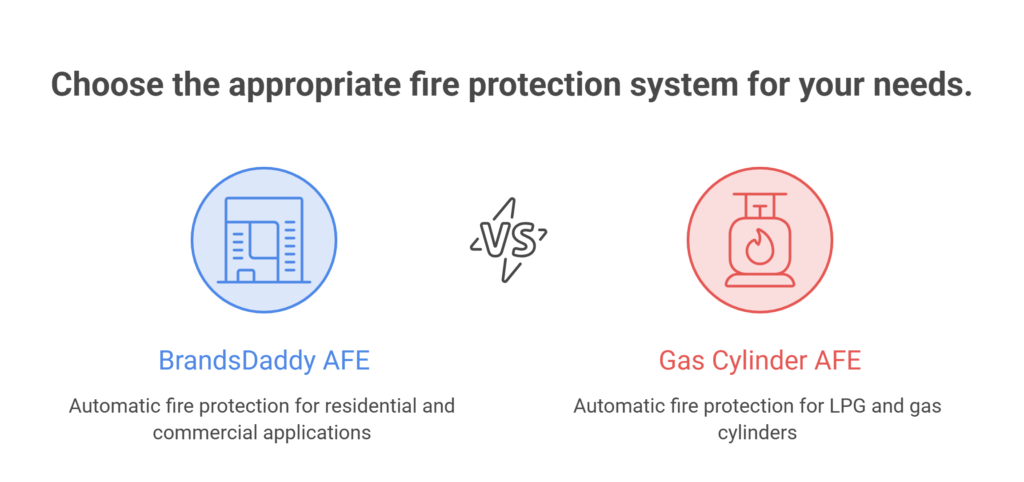
BrandsDaddy AFE provides automatic fire protection for suitable residential, commercial and other applications.
Gas Cylinder AFE addresses suitable LPG and gas-cylinder-related fire risks.
Car AFE brings automatic fire protection into suitable vehicle applications.
The technology may differ from one application to another, but the principle remains consistent:
Identify the risk first. Then select protection that suits the application.
Automatic Fire Protection for Homes
Modern homes contain more electrical and electronic equipment than ever before.
Refrigerators run continuously. Air conditioners operate for hours. Chargers remain connected. Inverters support essential appliances. Kitchens combine heat, electricity and LPG within a relatively small space.
Most of these systems operate safely when properly installed and maintained. Problems can arise when equipment overheats, wiring deteriorates, connections fail or appliances get used incorrectly.
A comprehensive home fire protection plan should therefore combine several layers:
- Safe electrical installations
- Responsible LPG handling
- Smoke or fire detection
- Suitable fire extinguishers
- Automatic fire protection for appropriate high-risk areas
- Clear evacuation procedures
- Regular safety checks
The National Institute of Disaster Management’s Fire Safety Awareness Materials provide government-backed fire-safety information covering prevention, preparedness and appropriate actions before and during emergencies.
An automatic fire extinguisher can add value where a fire may develop without immediate supervision.
The goal isn’t to create fear inside the home.
Preparedness should create confidence.
Why the Kitchen Deserves Special Attention
The kitchen combines several elements that require careful fire management: heat, cooking oil, electricity, combustible materials and, in many Indian households, LPG.
Leaving cooking unattended can allow a small problem to escalate quickly. Overheated oil can ignite. Electrical equipment can fail. A damaged LPG connection can create a dangerous situation.
Prevention should always come first.
Keep combustible materials away from cooking equipment. Maintain appliances and electrical connections. Handle LPG carefully. Never ignore unusual smells, sparks or overheating.
Suitable automatic kitchen fire protection can provide another layer in locations where early intervention matters.
A well-planned kitchen doesn’t rely on one product.
It combines safe behaviour, appropriate equipment and preparedness.
Gas Cylinder Fire Protection for Indian Households and Businesses
LPG powers millions of kitchens and supports restaurants, hotels and commercial establishments across India.
Its widespread use makes responsible gas-cylinder safety essential.
Our Gas Cylinder AFE focuses specifically on this environment. Its purpose is to provide an automatic fire-protection layer around suitable gas-cylinder applications.
Application-specific protection matters because fire risks vary considerably.
A gas-cylinder installation requires one approach. An electrical panel requires another. A commercial kitchen may need additional measures because cooking equipment introduces heat, oil and electrical risks simultaneously.
Understanding the hazard allows people to make better protection decisions.
That principle forms an important part of our approach to gas fire protection in India.
Protecting Vehicles From Fire
Vehicle fire safety often receives less attention than home or workplace safety.
A vehicle can contain fuel, wiring, batteries, electrical systems and high-temperature components. Different vehicle technologies introduce different risks, while a parked vehicle may remain completely unattended when a problem begins.
Our Car AFE addresses suitable vehicle applications with automatic fire protection in a compact format.
The solution can be considered for suitable applications involving:
- Petrol cars
- Diesel cars
- CNG vehicles
- Commercial vehicles
- Buses
- EVs
- Two-wheelers
- Three-wheelers
Vehicle fire protection should never depend on a single device. Drivers should maintain their vehicles properly, avoid unsafe electrical modifications and follow manufacturer recommendations.
Automatic protection can complement those precautions by adding another defensive layer near an identified risk.
Why Small Businesses Need Practical Fire Protection
Large companies may employ dedicated safety professionals and maintain extensive fire-protection infrastructure.
A small business often operates differently.
One person may manage a shop. A restaurant may have a compact kitchen with several heat sources. A workshop may operate machinery throughout the day. A warehouse might remain unattended overnight.
Limited manpower does not eliminate fire risk.
For smaller businesses, practical commercial fire protection can make a significant difference. The first step involves identifying vulnerable locations rather than purchasing equipment without understanding the hazard.
Ask where a fire could begin.
Examine which areas remain unattended.
Check how quickly employees could respond.
Review the existing fire-safety equipment.
Then determine whether additional automatic protection makes sense.
This approach turns fire safety from a checklist into a risk-management exercise.
Accessibility Means More Than Price
When we talk about accessible fire protection, affordability represents only one part of the equation.
People also need to understand the technology.
A homeowner should know what an automatic fire extinguisher does and where it can be appropriately installed. A business owner should understand which areas require additional protection. A vehicle owner should recognise the importance of maintaining fire-safety equipment.
Clear information helps people make better decisions.
That’s why education sits alongside product development in our work.
We want automatic fire protection to become something people can understand, evaluate and use responsibly—rather than a technical concept that feels relevant only to large industrial facilities.
Moving From Fire Extinguishers to Fire Protection Strategies
Owning a fire extinguisher does not automatically make a property fire-safe.
Effective protection begins with understanding the entire risk.
Where could the fire start?
What could cause it?
Who would notice it?
How quickly could someone reach the area?
What happens if the premises remain unattended?
Does the existing equipment address the likely fire risk?
These questions help build a more complete fire-protection strategy.
Automatic fire protection becomes one component of that strategy, working alongside prevention, detection, manual firefighting, evacuation and emergency response.
For conventional portable and mobile first-aid fire extinguishers, the Bureau of Indian Standards’ IS 2190:2024 covers selection, installation, maintenance and testing. The standard describes fire extinguishers as a first line of defence against fires of limited size.
BIS also lists IS 15683:2018 – Portable Fire Extinguishers: Performance and Construction among its fire-extinguisher standards. The standard addresses performance, reliability and safety requirements for portable fire extinguishers.
These standards are useful references when evaluating conventional portable fire-extinguisher requirements. However, the appropriate standard or specification for any particular automatic fire-protection product depends on the product design and intended application.
The strongest safety plans do not depend on one solution.
They create multiple opportunities to detect, control and escape a fire.
What Should You Consider Before Choosing an Automatic Fire Extinguisher?
Choosing fire-protection equipment should never begin with price alone.
Start by identifying the hazard.
1. Identify the Fire Risk
Determine whether the area contains LPG, cooking oil, electrical equipment, fuel, machinery or other combustible materials.
2. Consider Human Presence
Ask whether someone continuously monitors the area or whether the risk remains unattended for extended periods.
3. Select Appropriate Protection
Different fire risks and environments require appropriate suppression solutions.
4. Examine the Installation
Placement matters. The product should suit the intended environment and follow the applicable manufacturer and installation guidance.
5. Maintain a Layered Safety System
Combine automatic protection with conventional extinguishers, alarms, evacuation procedures and other appropriate fire-safety measures.
For conventional portable and mobile extinguishers, IS 2190:2024 provides an important Indian reference for selection, installation, maintenance and testing.
This approach helps homeowners and businesses make informed decisions instead of treating fire protection as a one-product purchase.
Our Approach
We started with a simple observation:
Fire protection should work for the environments where people actually face fire risks.
That means developing solutions with practical applications in mind.
Our work focuses on automatic fire protection for suitable residential, commercial, gas-cylinder and vehicle applications.
Innovation has limited value if people cannot understand or access it.
For that reason, our approach combines product development with awareness and education.
The objective is not to suggest that one product can solve every fire problem.
Instead, we want people to recognise risks earlier and consider practical protection before an incident occurs.
Aag Mukt Bharat: A Vision Built Around Awareness and Action
The idea behind Aag Mukt Bharat goes beyond extinguishing flames.
A safer India requires people to understand fire risks before those risks turn into emergencies.
That means teaching families how to prevent kitchen fires. It means helping businesses identify vulnerable areas. It means encouraging vehicle owners to take fire protection seriously. It means making practical fire-safety technology easier to understand.
Awareness creates the first step.
Preparedness turns that awareness into action.
Technology provides another layer of support.
Together, these elements can help build a stronger culture of fire safety.
For us, Aag Mukt Bharat represents that larger direction—a future where fire prevention and preparedness become ordinary parts of everyday life.
Automatic Fire Protection Is Not the Same as Being Fireproof
No fire-safety device can make a property completely immune to fire.
An automatic fire extinguisher has a defined purpose, operating range and application. Its effectiveness depends on factors such as the fire type, fire size, installation, activation conditions and surrounding environment.
Responsible fire protection therefore requires realistic expectations.
Use automatic protection where appropriate.
Keep conventional firefighting equipment available.
Install suitable detection systems.
Maintain electrical and LPG installations.
Create evacuation plans.
Contact emergency services when a fire exceeds safe personal intervention.
Good fire safety doesn’t depend on one product. It depends on preparation.
The Bigger Opportunity for India
India’s fire-safety conversation needs to extend beyond industrial facilities.
A small shop needs fire protection, family kitchen needs fire protection, parked vehicle needs consideration, warehouse needs a risk assessment.
An office needs electrical safety.
A restaurant needs a well-planned approach to cooking and fire hazards.
These aren’t isolated industrial problems.
They are everyday safety questions.
Making automatic fire protection more accessible gives more people an opportunity to address those questions before an emergency forces them to.
Building the Next Generation of Fire Safety
Fire protection will continue to evolve.
Sensors will become smarter. Detection will become faster. Suppression technologies will become more specialised. Connected safety systems will create new possibilities.
But technology alone won’t create safer communities.
People need to understand the risks.
Businesses need to assess their premises.
Households need to practise prevention.
Manufacturers need to build practical solutions.
Society needs to treat fire safety as a daily responsibility rather than an occasional requirement.
That is where we see our role.
At BrandsDaddy, we are working to bring automatic fire protection into more everyday applications while helping people understand why proactive fire safety matters.
Our journey is not about claiming that one device can prevent every fire.
It is about making appropriate protection easier to access, easier to understand and easier to consider.
The Best Time to Think About Fire Safety Is Before the Fire
Nobody plans to experience a fire.
That’s precisely why preparation matters.
You don’t install protection because you expect something to go wrong tomorrow. You install it because the consequences of being unprepared can be far greater than the effort required to prepare.
Automatic fire protection adds another opportunity to respond when a fire develops.
For a homeowner, that could mean protecting a high-risk area, for a business, it could mean addressing an unattended location, for a vehicle owner, it could mean adding another layer of protection around a potential fire source, for India, it represents one more step toward a stronger culture of preparedness.
At BrandsDaddy, we want that thinking to become part of everyday fire safety.
Because fire protection shouldn’t begin when the flames appear.
It should begin with the decision to be prepared.
BrandsDaddy
Automatic Fire Protection for a Safer, More Prepared India.
Frequently Asked Questions About Automatic Fire Protection
What is automatic fire protection?
Automatic fire protection uses fire-safety devices or systems designed to respond automatically when specified fire or heat conditions occur. It can provide an additional layer of protection without relying entirely on immediate human intervention.
What is an automatic fire extinguisher?
An automatic fire extinguisher is a suppression device designed to activate automatically when its specified activation conditions are reached and release a fire-suppression agent.
How does an automatic fire extinguisher differ from a conventional extinguisher?
A conventional extinguisher generally requires a person to identify the fire and operate the equipment. An automatic fire extinguisher can activate automatically under its specified operating conditions.
Can I use an automatic fire extinguisher at home?
Suitable automatic fire extinguishers can provide an additional layer of protection in appropriate residential applications. Selection and placement should match the identified fire risk and product specifications.
Where can automatic fire protection be useful?
Depending on the product and application, automatic fire protection can be considered for homes, kitchens, electrical areas, commercial premises, warehouses, gas-cylinder areas and vehicles.
What is a Gas Cylinder AFE?
A Gas Cylinder AFE is designed for suitable LPG and gas-cylinder-related fire-protection applications.
What is a Car AFE?
A Car AFE is an automatic fire-protection solution designed for suitable vehicle applications.
Does automatic fire protection replace a conventional fire extinguisher?
No. Automatic protection should complement conventional extinguishers, alarms, evacuation procedures and emergency response measures.
Does an automatic fire extinguisher make a building fireproof?
No. It provides a layer of fire protection but cannot guarantee that a building, vehicle or other environment will remain unaffected by fire.
What is Aag Mukt Bharat?
At BrandsDaddy, Aag Mukt Bharat represents our broader vision of encouraging fire awareness, prevention and access to practical fire-protection solutions across India.
BrandsDaddy: Making Automatic Fire Protection More Accessible
Fire safety doesn’t belong to one industry.
It belongs in our homes, businesses, vehicles, kitchens, workshops and communities.
That’s why we continue to develop practical automatic fire-protection solutions around everyday fire risks.
The objective remains clear:
Understand the risk.
Prepare for it.
Protect against it.
Act before a small fire becomes a major emergency.